

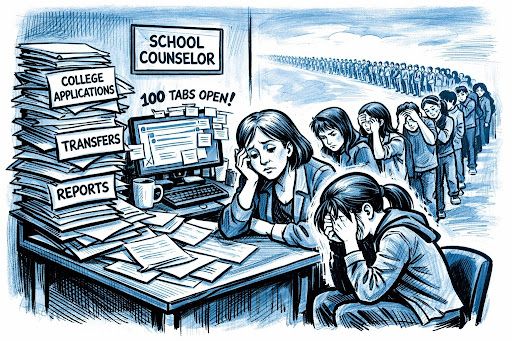
Imagine being in charge of helping hundreds of students with their schedules, college plans, mental health, and personal problems all at once. One minute, you’re taking on a freshman breakup, and the next, seniors are crashing out outside your office. How do you prioritize everyone, while still making time for yourself?
Neshaminy High School (NHS) has a student population of 2,850. According to the American School Counselor Association (ASCA), the recommended student-to-counselor ratio is 250 to 1, meaning each counselor should serve about 250 students. However, in many schools, counselors are responsible for far more students than this recommendation.
As someone interested in pursuing a related career, I initially estimated that the student-to-counselor ratio would be approximately 100 to 150 students per counselor. However, based on this information, I began to wonder how counselors manage such caseloads, considering that attending to 250 students—each with their own lives and individual concerns—must be a significant challenge for counselors.
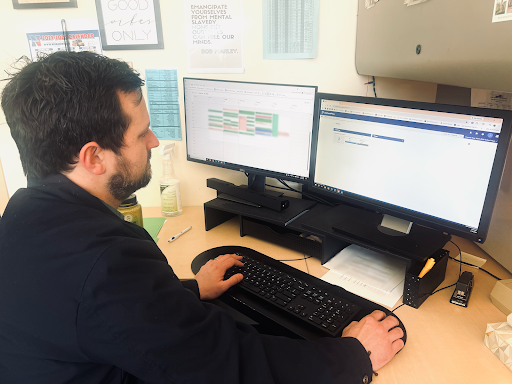
Building trust with a student can be either very easy or exceptionally challenging. NHS has 10 counselors as of the year 2026, each managing “approximately 280 students per case load,” according to Steve McAloon, an NHS assistant principal.
For many school counselors, managing a caseload of around 280 students may not be as overwhelming, but since every individual is different, some counselors might experience burnout faster.
“With 280-ish kids, it’s a little bit hard,” said an NHS counselor.
Many school counselors choose their profession driven by a sincere desire to support students in times of struggle, often unaware of the substantial challenges that come with the role. Despite these obstacles, most counselors remain committed and motivated by their genuine compassion and dedication.
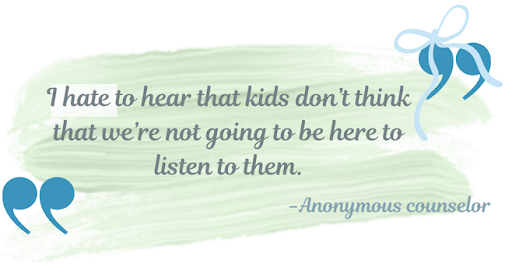
“I hate to hear that kids don’t think that we’re not going to be here to listen to them,” the counselor continued, underscoring the critical importance of their presence and accessibility.
Their unwavering support is essential in fostering a safe and trusting environment for students, emphasizing the vital role counselors play in shaping positive outcomes for young individuals.
But the job that requires listening to problems and putting the effort into actually solving them can burn anyone out sooner or later.
“When you see kids struggling in school, obstacles outside of school, like various factors [such as] socioeconomic status to family issues, you take it to heart,” mentioned an NHS counselor, Jeffrey McCaughey. He also mentioned that these factors do in fact “have adverse effects towards [his] mental health.”
According to a survey conducted at the NHS, completed by 118 randomly selected students, 52.5 percent of students reported being able to reach their counselor in time when they needed to talk, meaning that only about half of the students surveyed feel that they are able to reach their counselors when needed. This may reflect the availability of counselors for students during the school day.
When a student is in crisis and their counselor is unavailable, they are assigned to speak with another counselor. However, they might not feel comfortable sharing sensitive information with someone they don’t know as well as their own counselor.
“I feel like if I ever were having a bad day or something emotional going on, I wouldn’t be able to go to my counselor,” an NHS student said.
At the end of the survey, students were given the opportunity to suggest ideas they believe would benefit both counselors and students. The following responses are anonymous:
“Maybe counselors talk to their students more often and just get to know them.”
“I suggest that we have some more meetings throughout the year, because I only see my counselor when it’s to talk about my schedule or college.”
In the end, I’d like to say that NHS counselors do a great job, based on my personal experience. I think it is impressive how they handle the responsibilities put on them, not just with so many students, but also with family responsibilities and personal struggles. This only further highlights how overworked they are and how difficult it is to meet every student’s needs with the time and resources available.