


“I don’t believe in standardized testing as a means of judging students’ knowledge,” an Neshaminy High School (NHS) English teacher proclaimed.
When a teacher admits this, it forces us to ask an uncomfortable question: if tests are supposed to measure learning, why do they so often measure stress instead?
For millions of high school students, test days don’t feel like opportunities to demonstrate their knowledge. Instead, they view test days as high-pressure performances where one score can define their intelligence, effort, and even their future success.
Rather than inspiring growth, test culture often creates a mix of emotions such as anxiety, fear, and exhaustion. In a system that claims to value learning, it is worth asking whether traditional tests are truly necessary or whether they’ve become a normalized form of academic punishment.
Pressure over progress: The emotional costs of testing
Under the weight of academic burden, even the strongest students can feel overwhelmed. (The Playwickian/Brianna Smith)
In today´s schools, fear of failure is often louder than the desire to learn. What should be an environment built on curiosity and growth has become centered on scores and performances. As test dates approach, classrooms fill with tension and students feel the weight of expectations from teachers, parents, and themselves. Instead of focusing on understanding the material, many students focus on one thing: not messing up.
This constant pressure shifts the purpose of education. Learning becomes less about progress and more about proving intelligence through a single number.
Students cram information the night before, sit through exams with racing thoughts, and then quickly forget much of what they studied. When one test grade can outweigh weeks of effort, it sends the message that improvement does not matter, only perfection does.
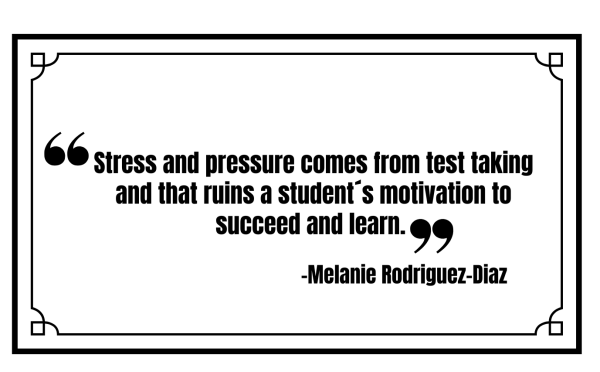
Students themselves acknowledge how damaging this environment can be. As Neshaminy student Melanie Rodriguez-Diaz explains, “Stress and pressure come from test-taking, and that ruins a student´s motivation to succeed and learn.”
Her words reveal the emotional costs of a system that prioritizes performance over personal growth. When anxiety becomes stronger than curiosity, education stops empowering students and starts overwhelming them.
Memorize, forget, repeat: The problem with test culture
The biggest flaw in test culture is that it rewards short-term memorization instead of real understanding. Students are pushed into a cycle of last-minute studying, repeating answers on an exam, and then forgetting most of it soon after.
As Lunney explains, “It becomes a pattern of studying the night before, dumping it, and then forgetting it.” When learning turns into ¨dumping¨ information, it stops being meaningful and starts feeling like a chore or even a punishment.
Research from Pub Med Central supports this idea. Studies on memory show that information learned quickly for an instant is far less likely to stay in long-term memory. The spacing effect, a well-known concept in cognitive science, proves that knowledge sticks better when it is practiced over time instead of memorized all at once for a single exam.
Traditional high-stakes tests rarely measure whether students truly understand the material; they mostly measure how much someone can temporarily recall under pressure
Instead of focusing on understanding or asking deeper questions, schools worry about what will appear on the test. And when students are reduced to a number based on what they could remember for a single class period, it sends the message that a single score matters more than effort, improvement, or true understanding.
More than a score: Students are not just numbers
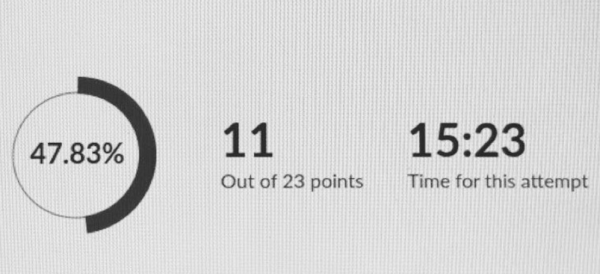
When a test score becomes the loudest voice in a room, everything else about a student— their growth, creativity, resilience, and even their personal challenges they quietly carry— gets silenced.
As Lunney explained, ¨There are a lot of outside exterior factors that could contribute to students not achieving success in those tests.¨
A timed, high-stakes exam cannot account for the lack of sleep, stress, family responsibilities, or learning differences. When a single score becomes the primary measure of intelligence, it overlooks the full picture of who a student is and how they actually learn.
Students feel this disconnect firsthand. NHS student Stephen Wade shared, ¨A test score doesn’t show how hard I worked or how much I improved – it just shows how I did in that one moment.¨
His words highlight a larger issue: performance under pressure is not always the same as understanding.
Research from the American Psychological Association has shown that test anxiety can significantly lower student performance, even when students know the material. When schools rely too heavily on standardized tests, they risk measuring stress and circumstances instead of true ability and growth.
Better ways to measure Success
If tests fail to capture real understanding, schools should consider more meaningful alternatives. Many educators support experiential and project-based learning because it allows students to apply knowledge instead of simply recalling it.
Writing assignments, presentations, portfolios, and real-world problem-solving allow students to explain their thinking and demonstrate growth over time. These methods measure progress, not just performance in a single moment.
Education has evolved in many ways, but assessment methods largely stayed the same.
As Lunney questioned, ¨If the world and technology have changed so much, why hasn’t education?¨
Preparing students for the real world means valuing critical thinking, collaboration, and creativity – skills that cannot be fully measured by multiple-choice exams.
When success is measured through deeper understanding rather than one test score, students are given a farrier and more accurate chance to show what they truly know and who they truly are. Until schools move beyond overreliance on standardized testing, education continues measuring pressure instead of potential.


