

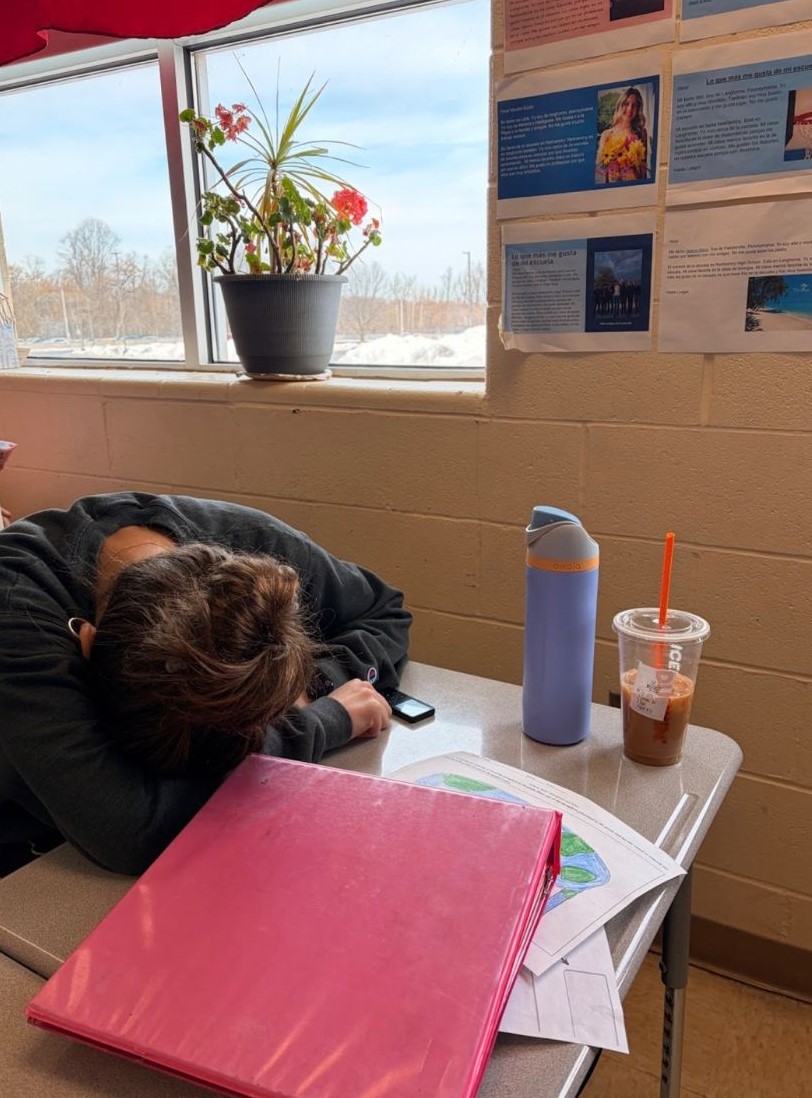
Why do we have to wake up so early to drag our sleepless bodies into school? Energy drinks replace water, heads lay on desks, and eyes fight to stay open as the first school bell rings. Many students begin their day exhausted and resort to caffeine and naps to get them through the day.
The reason for their exhaustion is quite simple. Puberty affects circadian rhythm. Circadian rhythm is the body’s internal clock that regulates sleep and alertness. During puberty, hormonal levels change, with the most important one being melatonin.
Melatonin, a hormone that controls the body’s sleep cycle, helps regulate circadian rhythm and signals to the body when it is time to sleep. Melatonin secretion can start around 11 p.m. to 1 a.m., with levels peaking around 4–6 a.m., according to RA Optics.
Teenagers feel sleepy in the morning because they wake up either during or shortly after their melatonin levels have peaked. This sleepiness is prevalent among students at Neshaminy High School (NHS).
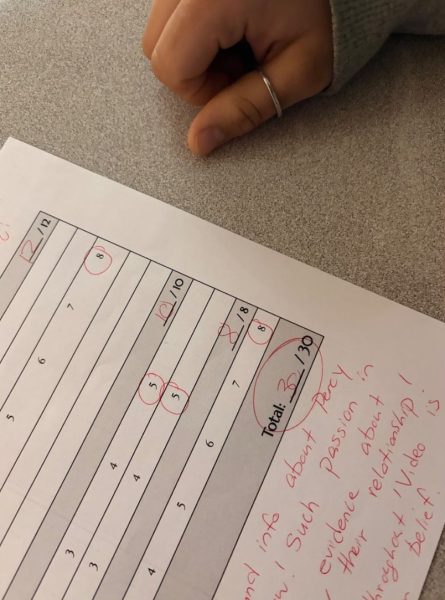
A survey conducted at NHS for the purposes of this article showed that 57.4% of students feel tired every day.
The early start times affect students’ academic performance.
“I’m struggling right now to study for my AP World and Spanish class because I got no sleep last night,” sophomore Ava Gonzales said.
Students fight against sleepiness as they try to focus in their classes.
“I have significantly less energy and have to focus on staying awake, while also participating,” sophomore Liora Gutman said. “When I don’t get enough sleep, I’m likely to do worse on the activities in class and have trouble remembering what we did later on.”
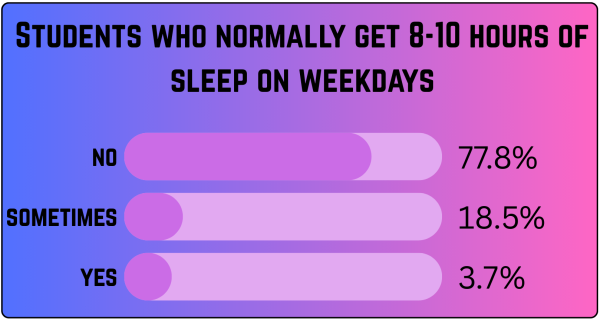
According to the American Academy of Pediatrics, teenagers aged 13–18 should sleep for eight to 10 hours. However, over half of NHS students don’t get the suggested hours.
Overall, the National Sleep Foundation found that almost 90% of high school students in the United States don’t get the recommended amount of sleep.
To make up for the lack of sleep, teenagers are resorting to energy drinks to give them energy. The National Institutes of Health reports that 30% of adolescents in the U.S. regularly consume energy drinks.
“[Energy drinks] energize me for the day,” Gonzales added. “They help me focus, and they’re so effective.”
Later start times have proven to be effective, as demonstrated by Pennsbury School District. The district implemented a later start time this school year after investigating the proposed change for several years prior. The decision was made after a community-wide survey showed that the majority of parents and students favored an 8 a.m. start time for the high school.
“The high school start time is way too early,” a Pennsbury survey-taker said before the delayed start times. “The [first] period teachers often called it the coffee club class since some allow coffee to wake the students.”

Start times later than 8 a.m. have proven to improve students’ attitudes.
“I remember the one time we had a two-hour delay,” an anonymous NHS student said. “I was literally so bubbly and positive, it was crazy. I performed the best at my rehearsals, and I was talking the most I ever had.”
Our education system is meant to prepare us with the knowledge and skills necessary to succeed in life post-graduation, but that is challenging to achieve when students are fighting to keep their eyes open.
Delaying the school start time would align with adolescent development and benefit numerous students. Since the evidence is clear, why doesn’t NHS look into a later start time?