
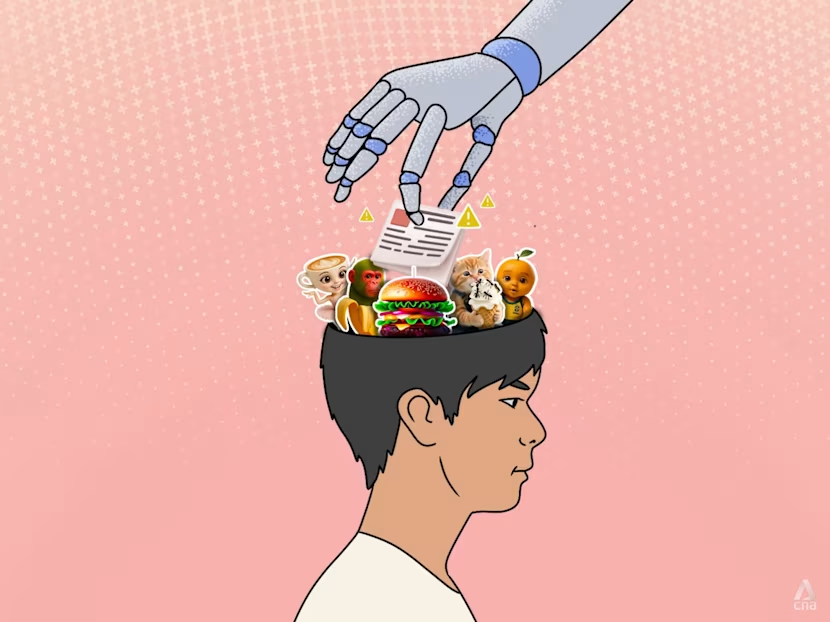
Artificial Intelligence (AI), becoming more advanced every day, perpetuates deepfakes and AI “slop”, continuing to trick the internet and confuse all generations into trusting what they view online. Apps like TikTok, Facebook, Instagram, and Snapchat enable the dissemination of AI-generated deepfakes to viewers.
All generations on social media, from Gen Z to Gen X alike, are in a constant state of wondering. They are unsure of what they should and shouldn’t believe when it comes to internet consumption nowadays.
“Everything you see and read, now you are questioning: ‘Did that really happen?’, or ‘Was this AI?’,” Gen X member Colleen Dunn said.
The older generations, though confused and suspicious of AI, are still shocked by what it’s capable of creating.
“It makes me question everything I watch now,” Dunn said. “It also amazes me to see how far technology has come to create such realistic situations.”
As the evolution of AI rises, people can’t help but think of the future flaws that are going to come from extensive use of AI at the rate that it’s going.
“If the cause of the accident was due to the AI technology of a car, it would be harder to hold people accountable for their actions,” Dunn said.
As the AI usage continues to grow, older generations are starting to believe that everything is AI because of how often they have been getting tricked with it [AI] recently.
“I am catching myself falling for AI,” Dunn said. “With the rapid growth of AI in technology, you almost need to assume it is AI-generated.”
As younger generations are navigating through the complexities of AI, they are starting to adapt to it as it goes on.
”I find myself falling for AI a lot less than usual now, because I’m used to it, but I used to fall for it all the time,” Gen Z member Emerson Rooney said.
The younger generations have grown up with AI and know how it’s affecting them. But, they also see the negatives to the increasing usage of AI.
“It’s taking away the knowledge of younger people,” Rooney said. “I would change the accessibility to AI because, like I said, it’s good for figuring out tough things, but people are overusing it.”
As AI advances in our technology, people are considering their future jobs and the potential detrimental impact AI can have on their workflow.
“Some possible detriments that we could foresee with AI are the ability to create more fake news,” Dunn said. “It can cause delays in our work and cause our job to be harder, not smarter.”
As technology advances, AI is being integrated into everyone’s everyday iPhones, making it easier to enhance photos and videos to improve their appearance and potentially deceive people into believing false information. Some generations have even experimented with AI on their own.
“The new iPhone’s ability to create your picture-perfect smile has become so easy,” Dunn said. “I have created a deepfake picture and video. No one realizes it is AI-generated or updated until I tell them.”
However, not everyone looks at the use of AI so positively. The younger generation sees that all generations are depending too much on AI.
“I think [the use of AI] should be lowered because people are relying on it,” Rooney said.
In contrast, others believe that AI is a process of growth. Some people see it as a natural tool we should continue to use.
“AI is reshaping how we look at everything,” Dunn said. “The use of AI should continue.”
Some people use humor to cope with the misunderstanding and confusion of AI deepfakes on the internet.
“I always joke around, saying ‘if you saw it on the internet, it must be true,’” Dunn said.