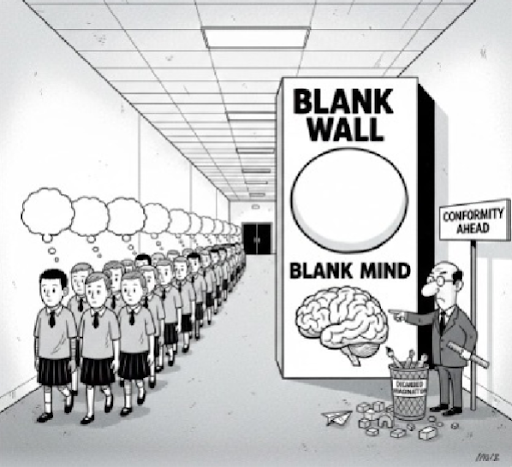


With the rise of social media, pop groups have been flaunted to many communities across the internet. But what happens when a group gains mass support overnight, only to be torn apart within seconds by constant scandals and internet discourse?
As social media continues to expand, countless aspiring artists have entered the world of pop groups. From competitive shows, emotional strain, and the challenge of working closely with people you barely know, the path to international success is far from glamorous. The polished image of these groups often hides the reality: a high?pressure environment where every moment is recorded, edited, and judged by millions.
Trainees and idols are expected to perform flawlessly while navigating intense competition, limited privacy, and the fear that a single online rumor could derail their careers. This pressure has become a defining feature of modern pop culture, and it’s only intensified by the internet’s ability to amplify conflict.
HYBE Corporation, one of the most influential and successful K?pop entertainment companies, has produced globally recognized groups such as BTS, Enhypen, LE SSERAFIM, NewJeans, and TXT. Hybe collaborated with the American label Geffen, home to legendary rock groups like Guns N’ Roses, Nirvana, and Aerosmith, to create a K?pop?inspired competition show: “Dream Academy.”
The collaboration marked a cultural crossover between K-pop’s rigorous trainee system and Western pop’s entertainment traditions, signaling Hybe’s ambition to expand beyond the boundaries of Korea’s music industry.
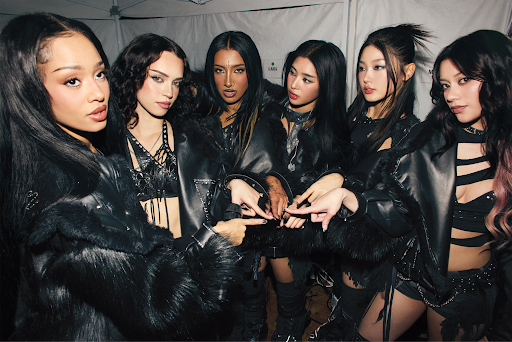
This 12?week global audition program, streamed on Hybe’s YouTube channel in September 2023, selected 20 finalists from over 120,000 applicants. After weeks of restless competition, five talented young performers, Lara Raj, Sophia Laforetza, Yoonchae Jeung, Manon Bannerman, Megan Skienidel, and Daniela Avanzini, formed girl group KATSEYE.
However, the polished image of stardom often hides the intense pressure placed on young performers. Contestants are exposed to millions of viewers before they even debut, and social media magnifies every moment.
During “Dream Academy,” for example, trainees like Bannerman became the center of online debates about rankings, favoritism, and editing, long before the group KATSEYE was finalized.
This pattern of recognition isn’t new; Zayn Malik’s departure from One Direction showed how constant speculation, fan theories, and internet discourse can fracture even the most successful groups. Even established idols like Lee Hee-seung from Enhypen have experienced how a single comment or departure from a group can explode into a trending topic overnight.
These examples reveal a larger truth: in the age of social media, pop groups are not only built online, but can also be torn apart there, too.
In retrospect, when idols get symbolized, their humanity gets lost, and groups end up suffering. This formula has been severely accurate as fans reacted harshly and egregiously to Manon’s hiatus due to the possible failed response that denied the full truth, seeming as a cover-up for what actually happened.
On Feb. 20, 2026, Hybe x Geffen Records (HxG) made an arbitrary hiatus announcement on Hybe’s global fandom platform, WEVERSE, as it described having thoughtful conversations regarding the status of Manon and where her attendance would be moving forward within the group. This led fans on different social media platforms, such as TikTok, Twitter, and Instagram, into a hazardous uproar, and many fans took to flooding comments and even arguing with each other about whether she was really on hiatus or not.
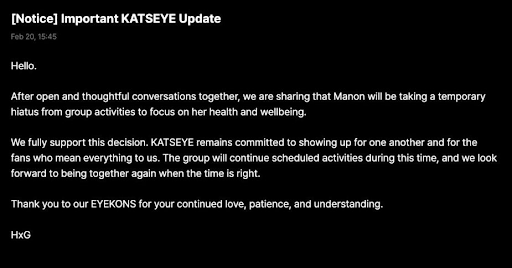
“After open and thoughtful conversations together, we are sharing that Manon will be taking a temporary hiatus from group activities to focus on her health and wellbeing,” HxG stated. “We fully support this decision. KATSEYE remains committed to showing up for one another and for the fans who mean everything to us. The group will continue scheduled activities during this time, and we look forward to being together again when the time is right.”
Many superfans recognized the familiar pattern: a member suddenly steps back “temporarily,” only to disappear from group activities entirely. This trope has become common in modern pop groups, from Western acts to K?pop idols like Enhypen’s Heeseung, who ended up leaving the group entirely for solo activity. Temporary hiatuses now trigger immediate panic in fans, parasocial overreactions, and even organized boycotts.
In KATSEYE’s case, rumors of bullying and exclusion spread faster than any verified information, echoing controversies faced by earlier groups, as fans speculate rumors of the girls bullying and leaving out Manon. This situation oddly parallels the controversies from other international pop groups such as One Direction and Fifth Harmony.
During the earlier days of Fifth Harmony, members such as Normani Hamilton described receiving abuse online. Some of the comments were a sign of bigotry and hatred and ultimately made her feel overlooked within the group, especially with her being the only African-American member.
This targeted harassment created a hostile environment that spilled into public perception of the group, causing other members, such as Camila Cabello, to depart from activities.
The topic became a social-media-driven spectacle, with conflicting statements posted online, fans creating a unique genre of parasocialism, “fanwars,” where fans argue with each other online about different famous individuals, often ending in hate speech and the ultimate escalation of the online situation at hand. Fans often pushed narratives about favoritism, mistreatment, and “who deserved more lines,” which intensified internal and external pressure.
On the opposite side of the coin with One Direction, rumors such as alleged feuds or negative relationships between the members spread rapidly online and sometimes strained real-life relationships.
Rumors about a secret romantic relationship between Harry Styles and Louis Tomlinson contributed to tension and public scrutiny.
Malik’s official exit from One Direction indirectly derailed the band’s legacy and the possibility of any long-term connection among the members.
When drama, rumors, fanwars, and parasocialism overtake the group’s hard work and musical intelligence, it’s hard as a member to even want to stay within the activities.
Malik was the first to leave the act, in the midst of a tour, after learning that his cohort was hesitant to keep going with the band.
“I knew something was happening, so I just got ahead of the curve,” Malik told the “Call Her Daddy” podcast (via BBC). “There were obviously underlying issues within our friendships, too. We’d gotten sick of each other if I’m being completely honest.
With narratives flying faster than official statements and individual members being targeted, these two instances– with One Direction’s being the main focal point– highlight the main idea that over the course of the past years, social media has significantly destroyed passionate artists’ mental health and even caused some individuals to completely leave the industry.
As new groups rise and social platforms evolve, the industry will keep grappling with the consequences of hyper?connected fandom culture. What happens next depends not only on labels and artists, but on the digital communities that surround them.
Sites used:
The Tragedy Of One Direction Explained – Grunge
Is Manon Leaving KATSEYE? A Complete Timeline From Hiatus to Coachella 2026 | Teen Vogue
Why the World Can’t Stop Talking About Katseye | Vogue
KATSEYE’s Manon Goes On Hiatus, Puts Out Statement Contradicting Her Label – Koreaboo