
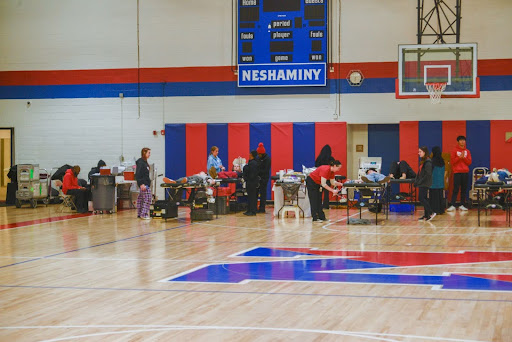
For more than a decade, Neshaminy High School (NHS)’s biannual blood drive has been a school and community tradition, one that fills Gym 1 twice a year with volunteers, Red Cross staff, and students hoping to make a difference. But in recent years, organizers have faced a growing challenge: participation is dropping.
The blood drive, run in partnership with the American Red Cross, has always relied heavily on student donors. Anyone who is at least 16 years old on the day of the drive is eligible to participate. According to Kimberly Kelley, a teacher at Neshaminy High School (NHS) who co-runs the event, the school used to see around 150 sign?ups per drive. As of December of 2025, those numbers have now been cut nearly in half.
The shift began around the same time two major changes impacted the school community: the COVID-19 pandemic and the expansion of dual-enrollment opportunities at Bucks County Community College. When NHS began allowing essentially any senior who wished to attend Bucks to do so, the pool of available donors shrank dramatically.
“We’ve noticed a big decline in participation since COVID, and since students have been able to dual enroll in Bucks,” said Marisa Quaranta, a teacher at NHS who has helped organize the blood drive with Kelley for the past 12 years. “We are having trouble reaching out to students and getting them to come donate when they are not in the building either in the morning or afternoon.”
Because students who attend Bucks are off campus for part or all of the school day, they’re simply not present when the Red Cross sets up in Gym 1. Even if they finish their college classes early, they are still often unable to donate. This has created a new barrier, one that has had a critical impact on the amount of donations.
This past drive, 98 students were processed, and only 74 were able to donate. While still meaningful, these numbers fall far short of the participation levels Neshaminy once saw. The decline has had ripple effects beyond the blood supply itself. NHS receives scholarship funding based on participation, and the drop in donors has cost the school thousands of dollars in potential awards.
The timing of the drives is intentional. They are scheduled during periods when car accident rates are statistically highest, ensuring that donated blood is available when it is most urgently needed. Every donation matters, and, as Quaranta emphasizes, every donation can help save up to three lives.
“Each donation can help up to three people and is essential for accident victims, surgery patients, cancer patients, people with anemia, and mothers during childbirth,” she explained. “Emergencies happen every day, and blood has a short shelf life, so regular donations are crucial to keep supplies available.”
Despite the challenges, both Kelley and Quaranta remain deeply committed to the program. Quaranta describes her involvement as meaningful and rewarding. “I am fortunate to be involved and grateful that this is something that we can run twice a year,” she said. “It is a positive way to impact the community, as most donated blood is used locally, helping people in our own area.”
Quaranta also believes in the value of student participation, but with an important caveat. “Donating is a direct way to make a positive impact. It is safe, supervised, and deeply meaningful. However, if the sight of blood, needles, etc. make students feel unwell, I do not believe they should participate.”
Mrs. Kelley shared a similar sentiment, noting that while male students typically drive participation because female students are more likely to be deferred for low iron, every eligible donor counts. And for those who choose not to donate, Quaranta’s approach is simple: “I would just give them all the information and respect their decision.”
Still, the organizers hope that more students, especially those who remain on campus full?time, will consider stepping up. With participation down nearly 50 percent from pre?COVID levels, the need for new donors is more urgent than ever.
The blood drive remains one of the most direct ways students can make a positive difference in their community. It requires no long?term commitment, no special training, and no cost. Just one donation can potentially save three lives.
As Neshaminy prepares for its next drive on April 24th, Quaranta encourages students, teachers, and staff to get involved. “I encourage students, teachers, and staff to donate at our next drive,” she said. “It’s a positive way to impact the community.”
The challenges are real, but so is the impact. With renewed awareness and a stronger push to reach students and get donations, Neshaminy’s blood drive can continue its tradition of service, one donor at a time.