


Have you ever been sitting in class surrounded by students who, for some reason, can’t just do their assignment? Or maybe you’re the one who can’t focus, and you wonder how some kids can just sit down and do homework for hours?
There’s one answer to both of these opposing questions: intrinsic motivation or one’s ability to engage for one’s own personal satisfaction.
Most of us live in a world where our teachers or coaches use the opposite, extrinsic motivation, to show improvement.
“That’s why you have a prize bucket, or you give a Jolly Rancher for a kid who volunteers or dumb stuff like that,” an anonymous Neshaminy High School (NHS) teacher commented.
So then, how does one develop intrinsic motivation?
It’s all about challenging yourself. It’s about being so scared to fail that you realize that you might have to take some time out of your day to look over the teacher’s notes.
“Isn’t our job as an educational institution to challenge students’ minds?” Assistant Principal Stephen McAloon asked. “The more rigor that [a student] experiences here at Neshaminy, the more prepared they are going to be when they get to college.”
Taking on challenging classes is a nerve-racking decision; however, this is where students get the opportunity to build true intrinsic motivation.
Don’t think you have to build this alone; teachers are always there to build up their students and work with them to gain that independent drive.
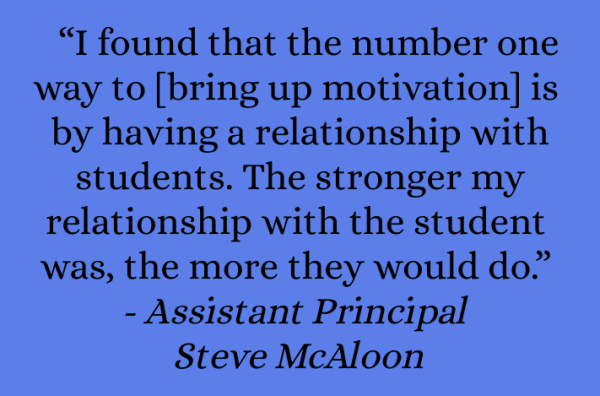
There are tools and resources that NHS offers to set each student up for success; they just have to find the drive to want to succeed above all else.
So next time you don’t feel like doing the assignment, consider how much better it would feel for it to be done out of your own enjoyment, or next time you’re wishing your classmates would stop talking, be grateful that you’ve unlocked a key to success that not everyone has.